Abraj Al Bait Towers
INTRODUCTION
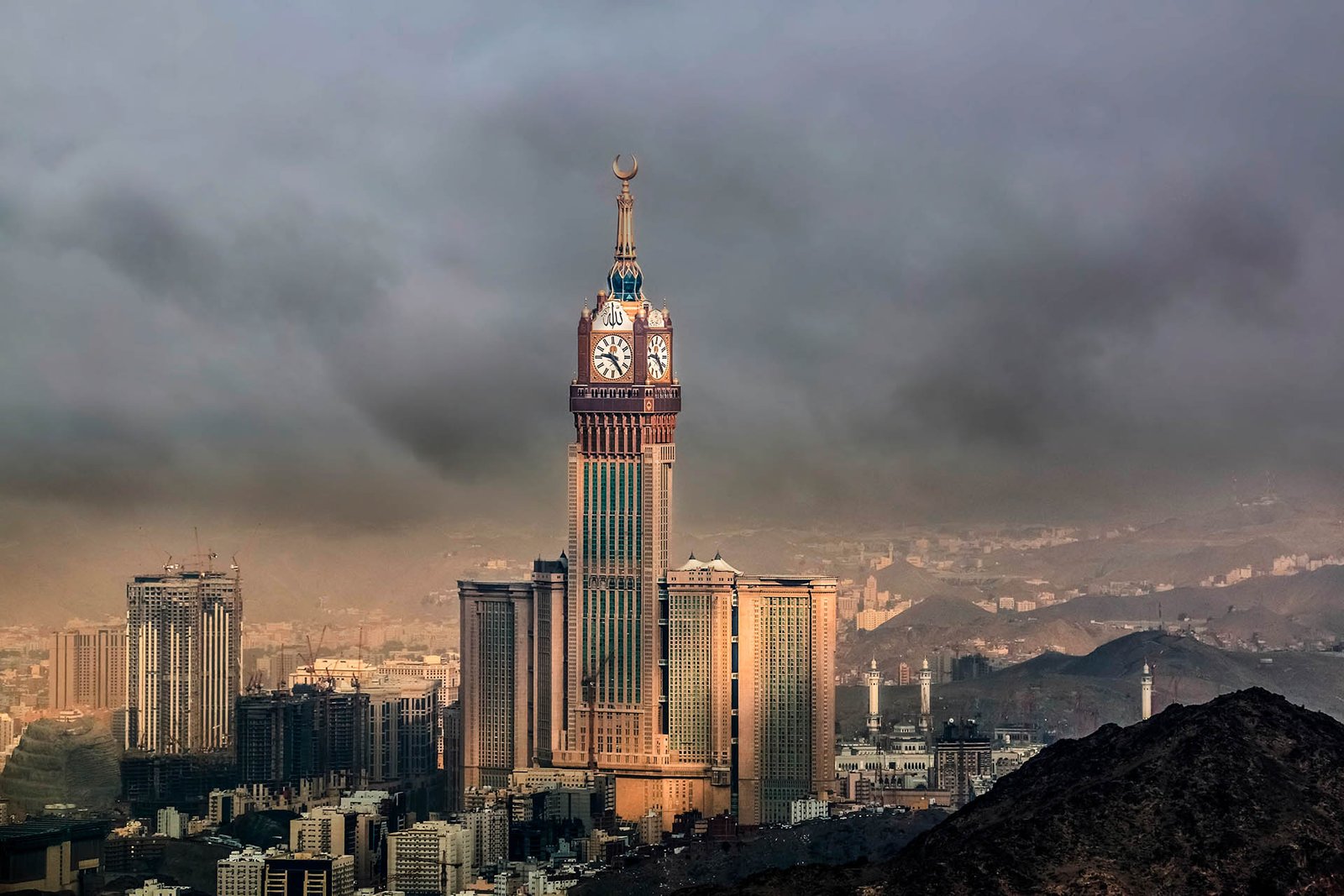
The Abraj Al Bait Towers rise sharply near the sacred city of Mecca in Saudi Arabia. This massive complex houses the world’s largest clock face and serves millions of pilgrims yearly. Its construction began in 2004 and finished in 2012, using high-grade concrete and steel designed to withstand winds exceeding 90 km/h. The towers reach heights over 601 meters, dominating the skyline. Officially a symbol of modernity, the project also sparked controversy. It allegedly replaced a 1,000-year-old Ottoman fortress, erased in secrecy during night bulldozing. Workers and locals claim the fortress’s stones were cursed, causing illness among bulldozer operators. This story remains disputed but adds a dark layer to the narrative. Curiously, this tale echoes rumors surrounding other Middle Eastern megastructures, such as the Jeddah Tower.
THE OFFICIAL STORY
The Saudi government presents Abraj Al Bait Towers as a pinnacle of engineering and hospitality. The complex includes seven skyscraper hotels built with reinforced concrete grades up to C50/60 to ensure durability and fire resistance. The tallest tower, the Makkah Royal Clock Tower, reaches 601 meters with a steel spire topping it at 93 meters. Designed to accommodate up to 100,000 visitors, the towers support Mecca’s growing pilgrimage demands. Construction involved around 12,000 workers from various countries, operating under strict schedules to meet deadlines before major religious events. The project adhered to Saudi building codes and international standards. The towers incorporate cutting-edge seismic design and wind tunnel testing to withstand desert storms. No official documentation mentions dismantling or disturbing any Ottoman-era structures. Instead, the narrative focuses on urban renewal and modernization to support religious tourism.
THE CONSPIRACY
Despite official accounts, rumors persist about the demolition of a 1,000-year-old Ottoman fortress beneath the towers. Allegedly, the fortress was bulldozed at night to avoid public outcry and international attention. According to unverified accounts, the bulldozer operators fell ill after disturbing the ancient stones, which locals believe were CURSED. The story circulates among Mecca’s residents and some construction insiders but remains unconfirmed by historians or government sources. This plausible construction secret suggests a cultural heritage loss hidden beneath the gleaming towers. The destruction allegedly erased centuries of Ottoman history, a time when the fortress guarded Mecca’s perimeter. The conspiracy parallels other claims of erasure near giant projects like the Palm Jumeirah, where environmental damage was also covered up. These tales highlight tensions between development and preservation in rapidly modernizing regions.
THE POSITIVE IMPACT
Abraj Al Bait Towers undeniably boosted Mecca’s infrastructure. The complex provides modern hotels, shopping malls, and prayer spaces supporting millions of pilgrims annually. It improved local economy by creating thousands of jobs during construction and operation. The advanced engineering techniques used set new standards for desert megastructures. The clock tower, visible from 25 kilometers away, helps pilgrims keep track of prayer times, enhancing religious experience. The project also integrated sustainable features like energy-efficient lighting and water recycling. For many, the towers symbolize Saudi Arabia’s ambition to blend tradition with modernity. Despite controversies, they fulfill critical needs by managing enormous visitor flows safely and comfortably.
THE BURIED INVENTION
Hidden beneath the surface, the project reportedly employed an innovative foundation design. The towers rest on a mat foundation over 15 meters thick, using high-strength concrete reinforced with fiber optics to monitor stress in real time. This system was pioneering for its time, allowing engineers to detect microcracks and shifts caused by seismic or thermal changes. The invention improved safety margins for supertall buildings in desert conditions. Additionally, a unique vibration damping system was installed to counteract wind-induced sway. This technology remains a milestone in structural engineering, influencing designs worldwide. The buried invention allowed the complex to rise safely on unstable ground near Mecca’s holy sites. It is a rare example of blending cutting-edge innovation with cultural sensitivity, even if the full history of the site remains clouded.
HUMAN COST & UNTOLD STORIES
Thousands of workers, mostly migrants, labored under intense heat, often exceeding 45 degrees Celsius. Reports suggest long hours with minimal breaks and limited safety measures. Allegedly, some workers experienced heatstroke and exhaustion, though official records remain silent on casualties. The rumored curse of the bulldozed stones added psychological strain on crews. Many workers kept silent about the heritage destruction fearing job loss or deportation. In one account, a bulldozer operator was hospitalized with mysterious symptoms after night shifts demolishing the fortress. Such stories remain anecdotal but reveal the emotional and physical toll behind the towers’ gleam. The human cost stretches beyond statistics to include lost heritage and broken connections to Mecca’s Ottoman past.
THE LEGACY
The Abraj Al Bait Towers leave a complex legacy. They represent Saudi Arabia’s leap into modern infrastructure but also a controversial erasure of cultural history. WHAT NO ONE ASKS: Why did regulators approve construction over a historic site? WHO BENEFITS from such rapid redevelopment? These questions linger as locals debate the price of progress. The towers also sparked global interest in preserving heritage amid urban growth. They remind us that architectural marvels come with shadows. This story connects with other regional projects like the Burj Khalifa, where human and cultural costs were also debated. The legacy challenges future builders to balance innovation with respect for history and people.
COMPARISON TO SIMILAR STRUCTURES
- Jeddah Tower — Both are Saudi megastructures with disputed construction controversies.
- Palm Jumeirah — Environmental and cultural concerns hidden beneath luxury development.
- Burj Khalifa — Worker exploitation and heritage loss shadowing iconic skyscraper.
THE LESSON
Progress must never erase history or human dignity. Building the future demands respect for the past and those who make it possible.
CALL TO ACTION
Subscribe to our newsletter to uncover more hidden stories behind the world’s greatest structures.
Leave a Reply